Harpy Eagle: Talons Up to 12.3 cm
Harpia harpyjaFemale harpy eagles average 12.3 cm talons, the largest of any living eagle, and weigh up to 9 kg. A pair raises just one chick every 2 to 3 years.
 Strange Animals EditorialMarch 13, 2025·13 min read·Editorial standards ↗
The harpy eagle is the largest bird of prey throughout its range and one of the heaviest eagles alive today. Unlike the open-country eagles that most people picture, golden eagles on steppe ridges or bald eagles over lakes, Harpia harpyja is a forest specialist.
It lives inside the tropical rainforest canopy, hunts from concealed perches rather than from the sky, and takes sloths and monkeys directly from the branches. A large female harpy can weigh as much as nine kilograms and carries the largest talons of any living eagle.
This guide covers every aspect of harpy eagle biology and ecology: size and strength, rainforest adaptations, hunting behaviour, diet, reproduction, social life, conservation status and the relationship between harpy eagles and the humans who share the Neotropics.
Etymology and Classification
The scientific name Harpia harpyja was first applied by Carl Linnaeus in 1758 in the tenth edition of Systema Naturae , under the older combination Vultur harpyja . The name refers to the Harpies of Greek mythology, winged beings with the bodies of eagles and the faces of women who snatched people and souls from the living world.
In Spanish the species is known as aguila harpia , in Portuguese as gaviao-real ('royal hawk') or harpia .
The harpy is the sole living member of the genus Harpia . Its closest relatives are the crested eagle ( Morphnus guianensis ) of the same Neotropical forests and the New Guinea harpy eagle ( Harpyopsis novaeguineae ), which despite the shared common name is a distinct species on a different continent. Together these three birds make up an informal grouping sometimes called the 'harpy group' within the family Accipitridae.
Size and Physical Description
Harpy eagles are the heaviest eagle in the Americas, heavier on average than bald or golden eagles, and among the top three heaviest eagles in the world alongside the Philippine eagle and Steller's sea eagle. Like many raptors they show reversed sexual size dimorphism, meaning females are substantially larger than males, here the gap is unusually extreme.
Males:
- Length: about 86-107 cm in total, across both sexes
- Wingspan: 176-224 cm, across both sexes
- Weight: typically 4-6 kg (average 4.4-4.8 kg)
Females:
- Weight: typically 6-9 kg (average 7.3-8.3 kg), a mean mass at least 35% above the male
Hatchlings:
- Fledging: at about 6 months
The wingspan is short relative to body mass compared with soaring eagles. This is not an oversight of evolution but a design trade-off. Harpies hunt inside forest canopy where long, narrow wings would catch branches and lose energy. Their shorter, broader wings and long tail give them extreme manoeuvrability between canopy branches.
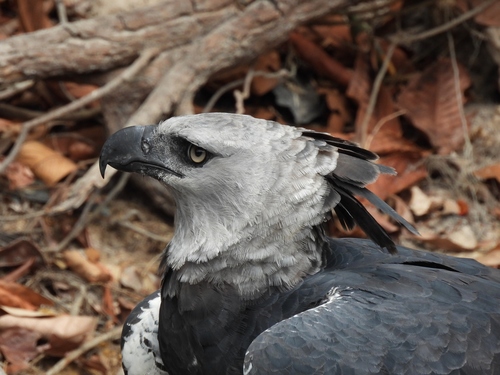
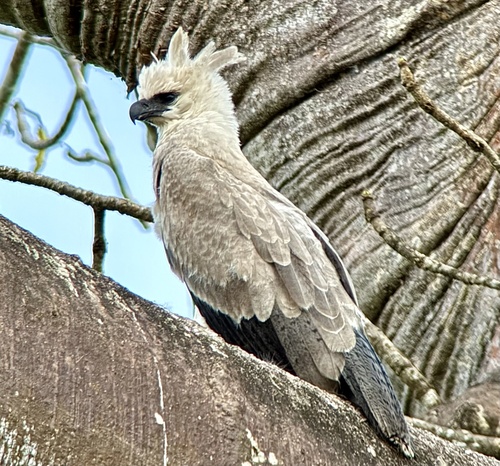
The head carries a distinctive double crest of long grey feathers that the bird can raise and lower at will. When flattened the crest disappears into a smooth skullcap, when raised it fans outward like a crown. Plumage elsewhere is two-toned: slate-black above and white below, with a broad black band across the upper breast and a pale grey head.
The legs are the harpy's signature weapon system. They end in feet armed with enormous talons, the largest of any living eagle. Mean talon length is about 8.6 centimetres in males and 12.3 centimetres in females.
Built for Forest Hunting
Every major feature of harpy eagle anatomy and behaviour is tuned to one task: killing medium-sized mammals in the closed canopy of tropical rainforest.
Anatomical adaptations:
- Short broad wings and long tail for tight turns between trees
Behavioural adaptations:
- Sit-and-wait hunting from concealed perches rather than aerial search
- Short, explosive attack flights rather than long pursuits
- Strong pair bonds and shared parental investment in single chicks
Hunting and Diet
Harpy eagles are obligate carnivores specialised for mid-sized arboreal mammals. The diet is heavily biased toward sloths and monkeys, with additional arboreal and occasionally terrestrial prey taken opportunistically. Diet composition varies with local prey availability, but the basic profile is consistent across the range.
Primary prey:
- Two-toed sloth ( Choloepus species), often the single most common prey
- Three-toed sloth ( Bradypus species), major prey across much of range
- Howler monkey ( Alouatta species)
- Capuchin monkey ( Cebus and Sapajus species)
- Spider monkey ( Ateles species)
- Woolly monkey ( Lagothrix species)
Secondary prey:
- Kinkajou ( Potos flavus )
- Coati ( Nasua species)
- Tamandua ( Tamandua species)
- Opossums and porcupines
- Iguanas and other large lizards
- Macaws and other large canopy birds
- Young deer and peccary (rarely, taken on the ground)
Females of this species routinely capture sloths and large monkeys weighing 6 to 9 kilograms, and harpies have been documented carrying prey weighing close to half their own body mass.
Hunting techniques:
- Perch-and-wait hunting. A harpy selects a hidden perch with clear sight lines into nearby canopy gaps. It then sits and watches for prey. When prey appears, the eagle launches in a short, fast dive.
- Branch-to-branch stalking. The eagle shifts position by moving between perches in short flights, allowing it to survey new canopy sectors.
- Nest and lair raids. Sloth infants, monkey infants clinging to mothers and arboreal mammal dens are targeted directly. The eagle crashes through thin foliage with talons extended and grabs the prey in the same motion.
- Opportunistic ground strikes. Harpies have been known to take peccaries, agoutis and young deer on the forest floor, typically near water sources or salt licks. Such strikes are rare but have been documented.
Life Cycle and Reproduction
Harpy eagle reproduction is extraordinarily slow by the standards of large raptors. Pairs are believed to mate for life. Nest trees, often emergent giants such as Ceiba pentandra (kapok) or the Brazil nut tree, may be used over several years.
Breeding cycle:
- Egg laying: usually 2 eggs, but the second is ignored and normally fails to hatch unless the first is lost
- Incubation: around 56 days, shared by the pair
- Hatching to fledging: approximately 5-6 months in the nest
- Post-fledging dependency extends another 6 to 10 months beyond fledging as parents continue to feed the young bird.
- Breeding frequency: a pair usually raises one chick every 2-3 years
The 2-3 year breeding cycle reflects the long period a chick stays dependent: it fledges at about 6 months, and the parents continue to feed it for another 6 to 10 months.
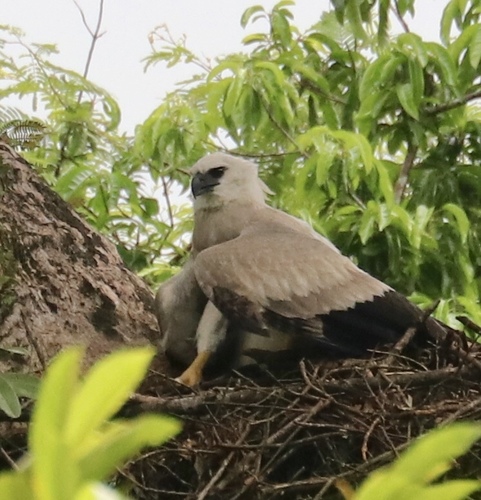
Nests are enormous platforms of sticks, commonly about 1.5 metres across and 1.2 metres deep, built high in the main fork of a tree, usually 16 to 43 metres above the ground.
Chicks fledge at about 6 months.
Breeding maturity is not reached until birds are 4 to 6 years old. Because a pair raises only one chick every 2-3 years, any sustained increase in adult mortality can drive local populations into decline.
Movement, Range, and Territory
Harpy eagles hold breeding territories whose size varies with habitat quality and prey density.
Territory data:
| Metric | Value |
|---|---|
| Area per breeding pair (Peru, average) | about 43 km^2 (4,300 ha) |
| Distance between active nests | 3 km (Panama, Guyana) to 7.4 km (Peru average) |
| Maximum elevation recorded | 2,000 m |
| Usual elevation | Below 900 m |
| Nest tree height | 16-43 m above ground |
| Typical nest diameter | about 1.5 m across, 1.2 m deep |
Populations and Distribution
The harpy eagle is rare and elusive throughout its range, and the total population is not precisely known, the largest numbers remain in the Amazon basin.
Geographic distribution by region:
| Region | Status |
|---|---|
| Amazon basin (Brazil) | Largest remaining population, generally continuous |
| Guiana Shield | Nests recorded (Guyana) |
| Amazonian Peru and Bolivia | Nesting pairs monitored in Peru |
| Amazonian Colombia/Ecuador | Nests monitored in Ecuador; confiscated birds released in Colombia |
| Central America | Nearly extinct; still seen in parts of Panama and Costa Rica |
| Southern Mexico | Probably occurs only in Chiapas (Selva Zoque) |
| Northern Argentina | Found only in Paraná Valley forests of Misiones |
Mexican and Central American losses are near-total. Atlantic Forest populations in Brazil are largely gone. The Amazon core holds most of what remains, but habitat loss and hunting remain threats there too.
Conservation Status and Threats
Harpy eagles are classified by the IUCN Red List as Vulnerable with populations declining. Every range state has designated CITES Appendix I protection, banning international commercial trade. While national safeguards exist throughout most of the species' range, enforcement remains uneven.
Primary threats:
- Habitat loss. Logging, cattle ranching, agriculture and prospecting remove the tall emergent trees that harpies require for nesting. Even selective logging can eliminate harpy territories if it removes the biggest nest trees.
- Forest fragmentation. Harpy eagles need extensive blocks of unbroken forest. Even though fragmented landscapes may hold individual birds, they rarely nurture stable breeding populations.
- Shooting. Harpy eagles are unafraid of humans at the nest and are large enough to be seen easily from the ground. Hunters shoot them out of fear or because they are seen as a threat to livestock.
- Pet and specimen trade. Harpy eagles are caught in wildlife trafficking, and confiscated birds have been rehabilitated and released in Colombia.
- Slow reproduction. The 2-3 year breeding cycle means recovery from any decline is extraordinarily slow. A population cannot rebuild quickly even when immediate threats are removed.
Conservation programmes include the Peregrine Fund's harpy eagle research and captive-breeding and release work in Panama and Belize, and nest monitoring in the Brazilian Amazon. Protected areas from Darien National Park in Panama to vast Amazonian reserves in Brazil and Peru provide the core of long-term habitat security.
The species' long-term outlook depends mainly on the fate of Neotropical lowland rainforest. Protection of emergent trees, reduction of shooting pressure and maintenance of large forest blocks are the most effective levers available.
Harpy Eagles and Humans
In Aztec religion the harpy eagle was sacred to Quetzalcoatl.
Panama has designated the harpy eagle as its national bird, and the species appears on the country's coat of arms.
Some hunters shoot harpies out of fear, believing them to be a threat to livestock or people. The eagle is not known to prey on humans and only rarely takes domestic stock, although one scientifically documented attack on an adult woman has been reported.
Illustration.
Frequently asked questions
Adult harpy eagles (Harpia harpyja) measure about 86-107 cm from beak to tail tip, with a wingspan of 176-224 cm. Females are much larger than males, typically weighing 6-9 kg against the males’ 4-6 kg, a mean mass at least 35% higher. That wingspan is shorter than many soaring eagles because the harpy hunts inside dense forest where broad wings provide manoeuvrability rather than cross-country lift.
Mean talon length is about 8.6 cm in males and 12.3 cm in females, the largest talons of any living eagle. Overall the harpy is the heaviest eagle in the Americas and one of the three heaviest living eagles in the world.
Harpy eagles are specialist predators of mid-sized arboreal mammals. Sloths (both two-toed and three-toed) and monkeys (howler, capuchin, spider and woolly) account for most of the diet. Other recorded prey include kinkajous, coatis, tamanduas, opossums, iguanas, macaws and young deer. Adult females regularly take prey weighing 6-9 kg, and harpies have been recorded carrying prey up to roughly half their own body weight.
Hunting is done mainly by perching and watching, then launching in a short dive to snatch prey directly from branches.
Harpy eagles inhabit lowland tropical rainforest from southern Mexico through Central America and across the Amazon basin to northern Argentina. They are most common in Brazil, and the Amazon holds the largest remaining numbers. They nest and hunt mainly in the emergent layer of tall forest, and build their huge nests in giant trees such as kapok.
Fragmented forest and disturbed areas rarely support breeding pairs. Breeding pairs need large areas of continuous forest, which is why habitat loss is so damaging to the species.
The IUCN Red List classifies the harpy eagle as Vulnerable with a decreasing population trend. The main threat is habitat loss from logging, cattle ranching, agriculture and prospecting. The species is nearly extirpated from much of Central America and is considered critically endangered in Mexico and Central America.
Shooting and wildlife trafficking add further pressure. Core Amazonian populations remain comparatively healthy, but the 2-3 year breeding cycle means recovery from any local decline is slow.
Harpy eagles reach breeding maturity at 4-6 years of age and then reproduce slowly: a pair usually raises one chick every 2-3 years. The female usually lays two eggs, but the second is ignored and normally fails to hatch unless the first is lost. Incubation lasts around 56 days, the chick fledges at about 6 months and the parents keep feeding it for another 6-10 months.
Because reproduction is so slow, the species is sensitive to adult mortality from shooting or habitat loss.
Harpy eagles possess the largest talons of any living eagle. Mean talon length is about 8.6 cm in males and 12.3 cm in females, and the legs are powerful enough to snatch live sloths and monkeys from tree branches.
Adult females regularly grab prey weighing 6-9 kg in flight and fly off with it, and harpies have been recorded carrying prey up to roughly half their own body weight.
The harpy eagle is the national bird of Panama and is depicted on the country’s coat of arms. The Peregrine Fund has run a harpy eagle conservation and research programme in Panama’s Darién Province since 2002, along with captive-breeding and release work in Panama and Belize.
The choice reflects the bird’s presence in Panamanian rainforests and its value as a flagship species whose protection requires protecting the wider ecosystem.
Harpy eagles are not known to prey on humans, but adults can be aggressive toward people who disturb a nest or appear to threaten their young. A scientifically documented attack on an adult woman has been reported.
Outside the nest, harpies generally avoid humans and are rare in disturbed areas. Hunters sometimes shoot them out of fear, although the eagle only rarely takes domestic stock.