Adelie Penguin: 13,000 km a Year on Ice
Pygoscelis adeliaeRoss Sea Adelie penguins migrate about 13,000 km a year along the pack ice edge, and their krill diet turns colony guano pink enough to map from satellites.
 Strange Animals EditorialMarch 12, 2025·17 min read·Editorial standards ↗
Of all penguin species in Antarctica, the Adelie penguin is the most widely distributed, the most purely Antarctic and the visual template that the largest number of people associate with penguins overall.
Pygoscelis adeliae breeds around the entire coastline of the Antarctic continent and its offshore island arcs, nests on bare gravel in vast open rookeries, builds heaped pebble nests and conducts courtship through an elaborate economy of stolen and re-gifted stones.
Discovered in 1841 and christened after the wife of a French explorer, this species has since earned the status of one of the world's most intensively studied seabirds. It serves as a living indicator of Southern Ocean krill health and, thanks to its striking blue-black and white tuxedo plumage, became an accidental pop-culture icon by design.
All major dimensions of Adelie penguin biology and ecology appear in this guide, including size and identification, plumage and anatomy, diving and foraging, pebble courtship and breeding, colony dynamics and long-distance movement, the coast migration pattern after the breeding season, conservation status, regional population differentiation, the Cape Adare colony and its place in Antarctic exploration, and how Adelie penguins connect with human affairs.
Etymology and Classification
The species was described in 1841 by the French naturalists Jacques Hombron and Honore Jacquinot, who sailed on the Antarctic expedition of Jules Dumont d'Urville, and was later placed in the genus Pygoscelis .
The expedition encountered large colonies of a small black-and-white penguin while surveying a stretch of East Antarctic coast that Dumont d'Urville claimed for France and named Terre Adelie , Adelie Land, after his wife, Adele Dumont d'Urville. The spelling "Adelie" is the French form of her name. The zoologists honoured her again by attaching the feminised Latin adeliae to the new species.
Both the geography and the bird have carried her name unchanged for nearly two centuries.
The genus name Pygoscelis comes from the Greek words for "rump" and "leg", a reference to the backward position of the legs and the stiff tail feathers that drag behind the bird when it walks. The genus contains three living species: the Adelie, the gentoo ( Pygoscelis papua ), and the chinstrap ( Pygoscelis antarcticus ). These three are collectively known as the "brush-tailed" penguins.
Molecular evidence suggests the Adelie lineage branched off about 19 million years ago, with the gentoo and chinstrap lineages diverging from each other some 5 million years later.
No subspecies of Adelie penguin are currently recognised. Genetic studies do identify two distinct lineages, one found primarily in the Ross Sea and the other widespread throughout the Antarctic.
Size and Physical Description
Adelies are small to medium penguins. They are smaller than gentoos, considerably smaller than kings and dwarfed by emperors. Within the Antarctic penguin fauna they are roughly the same size as chinstraps.
Adults:
- Length: 70-73 cm
- Weight: 3.8-8.2 kg; females weigh significantly less than males
Chicks at hatching:
- Covered in silver-grey down that is replaced by darker smoky-grey down within about 10 days
Chicks at fledging:
- Juvenile plumage with a white chin patch, no eye-ring yet
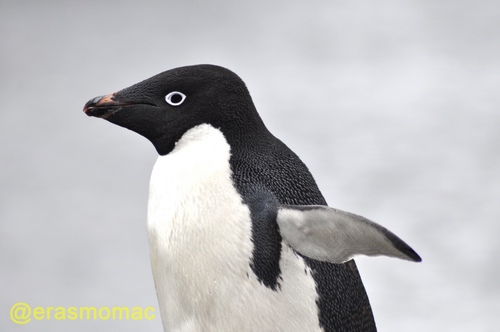
The Adelie is instantly recognisable. The back, flippers and head are pure blue-black, the belly and underside are clean white. The face is solid black with no facial markings other than a striking white eye-ring that gives the species a slightly surprised expression. Unlike gentoos there is no white head stripe, unlike chinstraps there is no black chin-strap.
The bill is largely covered with black feathers, leaving only the tip exposed. The feet are pinkish.
The tail feathers are long, stiff and prominent, one of the diagnostic features of the genus. On snow and ice the tail serves as a brake during tobogganing, dragging behind to slow descent on slopes and leaving a narrow groove between two lines of footprints. The overall body plan is the classic mid-size deep-diving penguin: torpedo-shaped in water, with dense bones, enormous chest muscles to power the flippers, and feet placed far back on the body so the bird stands vertically on land.
The Blue-White Tuxedo and Why It Inspired "Happy Feet"
The Adelie's plumage is the popular archetype of a penguin. A solid blue-black cap, back and tail, a clean white front, a black face broken only by a round white eye-ring. No extra colours, no stripes, no tufts. That simplicity is exactly what cartoonists and animators have always reached for.
The central chick in the 2006 animated film Happy Feet , Mumble, is rendered as an emperor penguin chick for narrative reasons, but the adult Adelies (the fast-talking, pebble-carrying "Amigos") are modelled directly on Pygoscelis adeliae .
In the water the tuxedo acts as countershading camouflage. Seen from above against deep water, the blue-black back blends into shadow. Seen from below against surface light, the white belly disappears against sky glare. This pattern is standard across penguins but reaches its cleanest, most unbroken form in the Adelie.
Built for Antarctic Life
The Adelie penguin is the most strictly polar penguin species alive. Unlike gentoos or kings, Adelies breed mostly along the Antarctic coast, follow the pack ice edge year-round and rarely venture north of 60 degrees South. Every feature of their biology is tuned to the Antarctic cycle.
Insulation layers:
- Outer waterproof feathers: short, stiff, densely overlapping, oiled by the uropygial gland
- Dense underdown: traps a still layer of warm air against the skin
- Subcutaneous fat: provides both insulation and fasting reserves
Thermal regulation features:
- Compact body shape: favourable volume-to-surface ratio
- Small flippers relative to body mass
- Counter-current blood flow in the legs and flippers, cooling blood before it reaches the feet and reducing heat loss to ice and cold water
Adelies tolerate some of the coldest operating conditions of any bird. They nest, walk and incubate eggs in strong winds and sub-zero temperatures. They can also enter freezing seawater repeatedly without losing body condition as long as food is available.
Pebble Nests and Pebble Theft
Adelies build open, cup-shaped pebble nests on bare gravel, typically on low rocky rises that stay free of meltwater during the brief Antarctic summer. High-quality pebbles are a genuinely limiting resource on the wind-scoured Antarctic coast.
During courtship and pair bonding, males search for smooth, rounded pebbles and present them to prospective or bonded females, who accept the stone and add it to the growing nest. The behaviour serves two functions at once. It signals the male's fitness and provisioning ability. And it physically contributes to a successful nest: Adelie eggs must be elevated above meltwater, mud and snow to avoid chilling and flooding.
The most prized pebbles are the smoothest, roundest and most uniformly sized stones. Such pebbles are repeatedly stolen from neighbouring nests, argued over loudly and sometimes re-gifted several times across a single colony.
Pebble theft is common. Pebble-related squabbles are among the defining social behaviours of an Adelie rookery.
Diet and the Pink Guano
Adelies are krill specialists. Antarctic krill ( Euphausia superba ) and ice krill ( Euphausia crystallorophias ) are the main prey, with small fish, primarily Antarctic silverfish ( Pleuragramma antarctica ), and pelagic amphipods rounding out the rest. Individual diet composition varies with colony location and year, tracking local krill abundance.
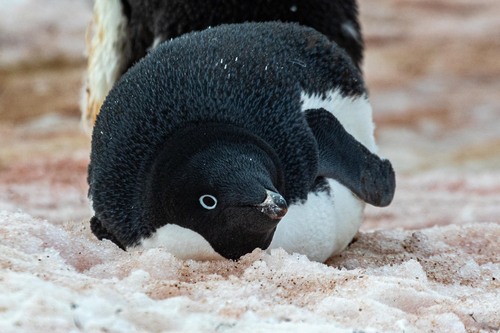
One of the stranger consequences of this diet is the colour of Adelie guano. Krill are rich in astaxanthin, a red-orange carotenoid pigment. Digested krill produce bright pink or red droppings.
Colony guano stains are so large and so distinctively pink that they are routinely used to map and count Adelie colonies from satellite imagery.
Diving and Foraging
Adelies usually swim at around 8 km/h and can leap about 3 metres out of the water to land on rocks or ice.
Adelies hunt by sight, usually during daylight and key their foraging to the upper water column where krill swarms concentrate. In thick pack ice conditions they use cracks, leads and breathing holes in ways superficially similar to seals. Birds can walk long distances across fast ice to reach productive feeding leads and return to the colony on the same commuting corridors.
Long Walks to the Colony
Some Adelie colonies sit far from reliable open water. At the start of the breeding season, colony sites may be up to 100 km from open water, and adults must walk across the sea ice to reach feeding grounds. On short legs designed more for swimming than walking, this is a major energetic expense and a strong selection pressure against colonies drifting too far inland.
Adelies use well-defined commuting routes across the sea ice, visible as packed paths worn by thousands of passing birds. Tobogganing on the belly with alternate flipper pushes is faster than walking on loose snow and becomes the preferred gait over longer distances.
Counter-Sharking at the Ice Edge
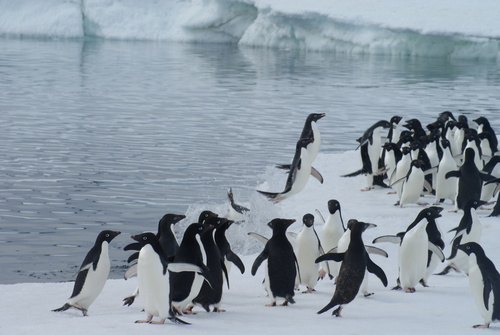
Leopard seals ( Hydrurga leptonyx ) ambush Adelie penguins at the ice edge where birds enter and leave the water.
At the moment of entry, Adelies use a collective strategy sometimes called "counter-sharking." A crowd gathers at the ice edge and nobody jumps first. The group shuffles forward, edges back, pushes, hesitates. Eventually one bird either jumps of its own accord or is nudged off the edge. If no predator surfaces within seconds, the rest of the flock cascades in. If a leopard seal appears, the remainder pull back.
The behaviour is a live example of risk-pooling in animal decision making and a favourite subject of Antarctic documentary footage.
Breeding Cycle
The Adelie breeding cycle is locked tightly to the short Antarctic summer. Adults arrive at the colony in late October, lay eggs in early-to-mid November and the last chicks fledge by early March. The entire sequence runs against the clock of the Antarctic summer light.
Annual timeline:
- Late October: Adults arrive at the colony. Males arrive first and reclaim nest sites; returning females rejoin the same partner in most cases.
- Early-to-mid November: Pebble nests rebuilt. Pair bonding. Two eggs laid, several days apart.
- Mid-November to mid-December: Incubation, 32-34 days. Parents alternate shifts, typically about 12 days each, while the other bird goes to sea to feed.
- Mid-December to mid-January: Guard stage. One parent always stays with the chicks while the other forages. Frequent short feeding trips.
- Mid-January to early February: Creche stage. Chicks gather in groups for warmth and safety. Both parents forage simultaneously, returning only to feed.
- Mid-February to early March: Fledging. Chicks moult into waterproof juvenile plumage and enter the sea for the first time.
- Late February to mid-March marks the period when adults molt annually, usually on ice floes or ice shelves and then depart the colony for the open pack ice.
Clutch size is two eggs.
Migration Along the Pack Ice Edge
Unlike some Antarctic seabirds, Adelies do not abandon the continent for temperate waters once breeding ends. Instead they follow the expanding winter pack ice edge, often covering very long distances along the Antarctic coast. Tracked birds from Ross Sea colonies migrate an average of about 13,000 km each year, and the longest recorded treks reach 17,600 km, following the ice edge to stay in sunlight before returning to the breeding colonies the following spring.
This strict tie to the pack ice edge is what makes the Adelie the "purest" Antarctic penguin.
Populations and Trends
Scientists currently estimate the global Adelie population at roughly 3.79 million breeding pairs distributed across more than 250 recognised colonies around the Antarctic coast and offshore islands. The figure comes from a 2014 census that combined satellite imagery with field surveys, and it makes the Adelie the most widespread penguin in Antarctica.
Regional trends are sharply divergent. East Antarctic and most Ross Sea colonies are stable or expanding, benefiting from sea-ice conditions that remain broadly favourable.
Antarctic Peninsula colonies are in clear decline, largely because the peninsula has warmed faster than almost any other place on Earth, the pack ice season has shortened and gentoo and chinstrap penguins are expanding south into ground that used to belong to Adelies. A 2007 report put the drop in peninsula populations at about 65% over 25 years, even as species-wide numbers remain high.
Conservation Status and Threats
The IUCN lists Adelie penguins as Least Concern with a very large and increasing population. The species is protected under the Antarctic Treaty System, which regulates all human activity on the continent,.
Primary threats:
- Regional sea ice change. On the Antarctic Peninsula, reduced and later-forming pack ice has cut Adelie foraging windows and depressed krill recruitment. In East Antarctica, by contrast, some areas have seen stable or slightly expanding pack ice, and Adelie colonies there are stable or growing.
- Krill fisheries. Commercial krill fishing operates in parts of the Southern Ocean used by Adelies for foraging. Competition is currently modest but could intensify if krill catch quotas rise.
- Avian influenza. Highly pathogenic avian influenza reached South America in 2022. In 2024 researchers reported more than 532 dead Adelie penguins on Heroina Island, with bird flu suspected as the cause. Outbreaks are extremely difficult to monitor or contain given colony size and remoteness.
- Tourism and research disturbance. A subset of Adelie colonies sit near frequently visited research stations and tourist landing sites. Managed well, such visits are low impact, poorly managed, they can displace nesting birds or increase exposure to pathogens.
- Oil and plastic pollution. Shipping and research activity in Antarctic waters brings low but non-zero risk of spills and plastic ingestion.
Species-wide the Adelie is not globally threatened. Regional subpopulations on the Antarctic Peninsula, however, are trending toward thresholds that could force reassessment at the regional level within the coming decades.
Cape Adare and the Scott Expedition
The Adelie penguin has a unique place in the history of Antarctic exploration. The great colony at Cape Adare , on the western side of the Ross Sea, is one of the largest and oldest known Adelie rookeries, with hundreds of thousands of pairs nesting on a narrow pebble beach under a sheer cliff. It was one of the first Antarctic sites occupied for sustained scientific work.
During the British Antarctic Expedition of 1910-1913 led by Robert Falcon Scott, the Northern Party under Victor Campbell overwintered at Cape Adare in 1911 and 1912, and the expedition surgeon George Murray Levick observed the Adelie colony through an entire breeding cycle. The party's hut has fallen into ruin, but the earlier huts built there by Carsten Borchgrevink's expedition in 1899 still stand, and the site is protected under the Antarctic Treaty System.
Adelie Penguins and Humans
Human contact with Adelie penguins is almost entirely scientific and logistical. There is no Indigenous hunting tradition for the species because Antarctica has no permanent Indigenous human population. Today, interactions are dominated by research stations, long-running monitoring programmes and tightly regulated tourism.
Adelie colonies are among the best-studied seabird populations in the world. Long-term banding and automated weighbridge projects at colonies like Bechervaise Island, Cape Crozier and Petermann Island now span multiple decades. These programmes provide some of the most detailed data available for any wild bird on breeding success, adult survival, prey availability and climate linkage.
Tourism is carefully managed under the International Association of Antarctica Tour Operators guidelines. Visitors stay at minimum distances, never touch or block birds and follow strict biosecurity protocols to reduce the chance of introducing pathogens.
The species' cultural footprint is outsized. The name Adelie, through Terre Adelie and Happy Feet and a century of explorer diaries and National Geographic specials, is recognised by millions of people who could not name any other penguin. For a bird that lives on the edge of the world and never meets most of the humans who love it, that is an unusual reach.
Frequently asked questions
Adult Adelie penguins (Pygoscelis adeliae) measure about 70-73 cm in length and weigh 3.8-8.2 kg. They are smaller than gentoos, kings, and emperors, and roughly the same size as chinstraps. Females have shorter wings and beaks and weigh significantly less than males, although the sexes look alike.
Chicks moult into juvenile plumage and go out to sea after roughly 50-60 days.
Adelie penguins are krill specialists. Antarctic krill (Euphausia superba) and ice krill (Euphausia crystallorophias) are the main prey, with small fish, primarily Antarctic silverfish (Pleuragramma antarctica), and pelagic amphipods making up the rest.
Foraging trips are short and inshore during the guard stage and lengthen once chicks are old enough to creche. The pink or red colour of Adelie guano reflects a krill-rich diet.
Adelie penguins breed around the entire Antarctic coastline and on nearby offshore islands. Major colonies sit on the Antarctic Peninsula, the South Shetlands, the South Orkneys, the South Sandwich Islands, the Ross Sea coast (including the enormous Cape Adare and Cape Crozier rookeries), Adelie Land and the East Antarctic coast.
They prefer ice-free, snow-free coastal ground for nesting, typically bare gravel, pebble beaches, or low rocky outcrops, within reach of open water and pack ice for foraging. Outside the breeding season they follow the pack ice edge, and they are much less common north of 60 degrees South.
The IUCN lists Adelie penguins as Least Concern. A 2014 census based on satellite imagery and field surveys estimated 3.79 million breeding pairs in 251 colonies, making this the most widespread penguin in Antarctica.
Trends are regionally divergent: Antarctic Peninsula colonies have declined, largely because of reduced sea ice and competition with expanding gentoo and chinstrap populations, while increases in East Antarctica have been larger. Secondary threats include krill fisheries overlap, avian influenza (suspected in a 2024 die-off of more than 532 Adelies on Heroina Island), oil and plastic pollution and disturbance at tourism-heavy colonies.
The species is not globally threatened but some regional subpopulations could cross threat thresholds in coming decades.
Adelie penguins build open pebble nests on bare ground, and high-quality pebbles are a genuinely limiting resource on the wind-scoured Antarctic coast. During courtship and pair bonding, males search for smooth, rounded stones and present them to prospective or bonded females, who accept the stone and add it to the growing nest.
The behaviour serves two functions at once: it signals the male’s ability to provide, and it physically contributes to a successful nest because Adelie eggs must be elevated above meltwater, mud and snow to avoid chilling and flooding.
The most prized pebbles are the smoothest, roundest and most uniformly sized stones, such pebbles are repeatedly stolen from neighbouring nests, argued over loudly and sometimes re-gifted several times across a single colony. Pebble theft and squabbling are among the defining social behaviours of an Adelie rookery.
The Adelie penguin takes its name from Adelie Land (Terre Adelie), the stretch of East Antarctic coast that French explorer Jules Dumont d’Urville discovered in 1840 and named after his wife, Adele Dumont d’Urville. The penguin was described scientifically in 1841 by Jacques Hombron and Honore Jacquinot, naturalists on his expedition.
The scientific name Pygoscelis adeliae carries the feminised Latin form of the same name, and both the geography and the bird have carried it for nearly two centuries.
References
- Relevant peer-reviewed and governmental sources consulted for this entry include IUCN Red List assessments for Pygoscelis adeliae, SCAR (Scientific Committee on Antarctic Research) population reports, CCAMLR ecosystem monitoring program data, long-term monitoring publications from the Palmer LTER and Ross Sea colonies, and published research in Marine Ecology Progress Series, Polar Biology, Journal of Avian Biology, and Nature Climate Change.
- Population figures reflect the most recent consolidated circumpolar estimates derived from combined ground surveys and satellite imagery analysis of colony guano extents.