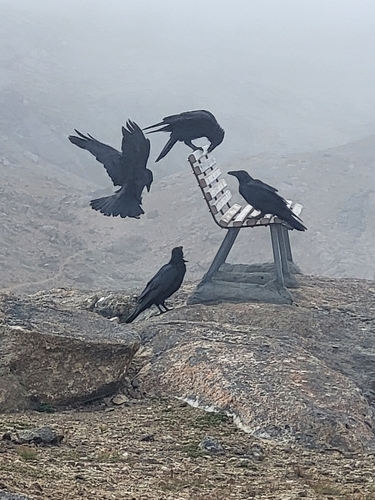
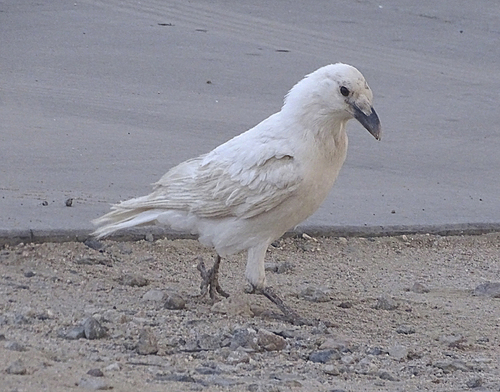
Common Raven: Seen at 6,350 m on Everest
Corvus coraxWeighing up to 2.25 kg, the common raven is the heaviest passerine alive, and one assessment suggests four-month-old ravens match adult chimps on some tests.
 Strange Animals EditorialJuly 2, 2025·15 min read·Editorial standards ↗
The common raven is the heaviest songbird and one of the most intelligent birds. Corvus corax is a true passerine, a member of the order that contains sparrows, wrens and finches.
The raven occupies more of the Northern Hemisphere than any other corvid, from Arctic tundra to desert.
This guide covers the full biology, behaviour and ecology of the common raven: size and anatomy, range, diet, hunting and scavenging, reproduction, social life, intelligence, vocal culture, the famous raven-wolf partnership and the species' extraordinary mythological weight.
Etymology and Classification
The scientific name Corvus corax was formalised by Carl Linnaeus in 1758. Corvus is Latin for 'raven' or 'crow', and corax is the Latinised form of the Greek korax, meaning 'raven' or 'crow'. The English word 'raven' descends from Old English hraefn and Proto-Germanic hrabanaz . Across Europe the species carries a family of related names, German Rabe , Dutch raaf , Old Norse hrafn .
The common raven is one of the species in the genus Corvus , the group that contains crows, rooks, jackdaws and the larger ravens of Africa and Australia. Along with the thick-billed raven of the Horn of Africa, it is one of the two largest corvids.
Authorities recognise between eight and eleven subspecies across its vast range, with differences in body size and bill shape. Genetic studies show that the California population ( Corvus corax clarionensis ) is distinct from the Holarctic ravens and closer to the Chihuahuan raven, which makes the species as traditionally defined paraphyletic.
Size and Physical Description
Common ravens are the heaviest passerines alive today. The size range is wide because the species spans continents and climates, and birds from colder regions such as the Himalayas and Greenland are generally larger than those from warmer regions.
Body dimensions:
- Length: 54-71 cm from beak to tail
- Wingspan: 1.16-1.53 m
- Weight: 0.69-2.25 kg, averaging about 1.47 kg at maturity
- Culmen length: 5.7-8.5 cm
- Tail length: 20-26 cm
Distinguishing features:
- Wedge-shaped tail, visible in flight silhouette
- Shaggy 'hackles' on throat, elongated pointed feathers
- Heavy, deeply curved bill with a pronounced culmen
- Long primary flight feathers creating a raptor-like wing shape
- Entirely black plumage with iridescent blue, purple, or green sheen in direct sunlight
- Black legs, feet and bill, with a dark brown iris in adults
Males average slightly larger and heavier than females but the difference is not reliable from field observation alone. Unlike many raptors the two sexes share identical plumage. Juvenile ravens have a blue-grey iris and duller plumage.
In flight the raven is immediately distinguishable from any crow. Crows flap steadily and rarely glide far. Ravens soar on flat or slightly raised wings like a buzzard, perform acrobatic rolls and tumbles and routinely ride thermals to impressive altitudes. Ravens have been recorded as high as 6,350 m on Mount Everest.
Range and Habitat
The common raven holds the widest natural distribution of any corvid and one of the widest of any songbird on Earth. Its range covers most of the Northern Hemisphere.
Global distribution:
| Region | Status |
|---|---|
| North America | Alaska, Canada, western US, Mexico, Central America |
| Europe | From Iberia and the Mediterranean to the Arctic coast |
| Asia | Russia, Mongolia, China, Himalayas, Middle East |
| North Africa | Atlas Mountains, coastal Morocco, parts of Egypt |
| Arctic | Greenland, Iceland, Svalbard, high-Arctic Russia |
Ravens occupy almost every terrestrial habitat in this range. They breed on sea cliffs in Cornwall and the Faroes, in Arctic tundra, in boreal spruce forest, in temperate deciduous woodland, on desert cliffs in Arizona and the Sahara, in high mountain meadows above 5,000 m, and in expanding numbers in cities and industrial landscapes.
The common raven's success across climates is tied to its generalist diet, its intelligence and its willingness to scavenge from any abundant food source.
Diet and Foraging
Ravens are among the most generalist feeders of any bird. Their diet varies widely with location, season and opportunity.
Main food categories:
- Carrion. Dominates the winter diet across most of the range. Ravens follow wolves, coyotes, large raptors, human hunters and roadways to reach carcasses.
- Small vertebrates. Voles, mice, lizards, snakes, young rabbits, nestling birds. Ravens kill small prey directly with a stabbing strike of the bill.
- Eggs and nestlings. Ravens are regular predators at bird nests, and in the Mojave Desert they prey on juveniles of the threatened desert tortoise.
- Insects and molluscs. Seasonally important, especially during spring and summer when caterpillars, beetles and grasshoppers are abundant.
- Fruit, grain and seeds. Ravens raid crops, dumpsters, livestock feeding troughs and autumn berry crops with the same efficiency.
- Human refuse. Landfill sites, campgrounds and urban streets support permanent urban raven populations in much of their range.
- Cached food. Ravens store surplus food and hide it out of sight of other ravens.
The raven's feeding style is opportunistic but organised. Ravens call to recruit other ravens to large carcasses. Juveniles routinely travel in flocks around a single large carcass, overwhelming the territory-holding adult pair by sheer numbers, a strategy described by biologist Bernd Heinrich in his long-term Maine studies.
Reproduction and Life Cycle
These birds form lifelong pair bonds that endure until one partner dies. Courtship displays in pairs include spectacular aerial moves like rolls, tumbles, synchronised dives and preening at the roost. Juveniles start courting early, yet they may not bond until two or three years have passed, and breeding pairs need to hold a territory before they can nest.
Breeding timeline:
- Late winter to early spring: courtship feeding, nest building, copulation
- Late January or February to April: eggs laid (as late as April in colder climates such as Greenland and Tibet)
- 18-21 days: incubation, by the female only
- 35-49 days: nestling period to first flight
- Up to about six months: young stay with their parents after fledging
Clutch characteristics:
- Egg count: 4-6 (rarely 2-7)
- Egg colour: pale green or blue-green with darker mottling
Nests are deep bowls of large sticks, bound with roots, mud and bark and lined with softer material such as deer fur. Pairs tend to nest in the same location for life.
Preferred nest sites include tall trees, cliff ledges, power pylons and large man-made structures.
Parents defend their young vigorously and are usually successful at driving off threats such as owls and eagles, and humans who get close to a nest may be attacked. Young birds may travel in flocks before they pair and take a territory.
Intelligence and Cognition
The brain of the common raven is among the largest of any bird species, and ravens show problem-solving, imitation and insight.
Documented cognitive abilities:
- Tactical deception. Ravens watch where other ravens cache food and steal from them, and have been observed pretending to make a cache without depositing the food, presumably to confuse onlookers.
- Social cognition. A large-scale assessment suggests that by four months of age ravens do about as well as adult chimpanzees and orangutans on tests that include causal reasoning, social learning and theory of mind.
- Insight. In a string-pulling test, four of five ravens eventually reached food hanging from a perch with no demonstrable trial-and-error learning. Ravens have also been observed breaking off twigs to play with socially.
Vocalisations and Dialects
Ravens have a wide and complex vocal repertoire. Fifteen to 30 categories of calls have been recorded, most used for social interaction, including alarm calls, chase calls and flight calls.
Representative call types:
- Kraa. A dry, grating call.
- Toc-toc-toc. A high, knocking call.
- Yell. A drawn-out food-recruitment call that attracts other ravens to a large carcass.
Like other corvids, ravens can mimic sounds from their environment, including human speech.
The Raven-Wolf Partnership
Few cross-species relationships have attracted as much scientific attention as the one between common ravens and grey wolves. Across the boreal forests, tundra and mountain ranges of the Northern Hemisphere the two species are associated: ravens follow wolves to scavenge their kills and have been observed leading wolves to prey.
Ravens are not equipped to tear through large carcasses and must wait for another predator to open them. Wolves solve that problem. Ravens in turn:
- Spot carcasses from the air and call wolves toward them
Bernd Heinrich proposed that juvenile ravens call other ravens to a new carcass so that they can outnumber the territory-holding pair and feed.
Play Behaviour
Ravens play. They play aerially, socially and with objects. Observed play includes:
- Aerial barrel rolls, tumbles and inverted flight with no territorial or courtship context
- Sliding down snowbanks
Conservation Status
The IUCN Red List classifies the common raven as Least Concern . In the United Kingdom the range is increasing after improved legal protection, though illegal persecution by gamekeepers remains a problem in many areas. In some regions ravens have taken advantage of landfills, roads and human settlement and have increased sharply.
Current conservation issues:
- Range expansion. In the western Mojave Desert, human settlement has led to an estimated 16-fold increase in the raven population over 25 years, helped by landfills, water sources and nesting sites on utility poles. This creates conflict with the threatened desert tortoise, whose juveniles ravens prey on.
- Persecution. Ravens remain legally or illegally killed in some livestock regions. Control measures such as shooting and trapping have been used or planned in parts of the American West and Alaska.
Despite these pressures the common raven is rated Least Concern. The harder question is how to balance a successful predator with the threatened species it preys on.
Ravens in Culture and Mythology
Few animals carry the cultural weight of the raven. The species appears in foundation myths, funerary practices and royal legends across three continents.
Norse tradition. The god Odin is accompanied by two ravens, Huginn meaning 'thought' and Muninn meaning 'memory', who fly across the world each day and return to whisper what they have seen into his ears.
Celtic and British tradition. In Irish mythology the goddess Morrigan alighted on the hero Cú Chulainn's shoulder in the form of a raven after his death. The mythological British king Bran the Blessed shares his name with the Welsh word for raven. A legend holds that England will not fall to a foreign invader while ravens remain at the Tower of London, though the Tower's official historian believes this is a Victorian invention.
Native American traditions. In Tlingit and Haida cultures of the Pacific Northwest, Raven is both a trickster and a creator god. Related beliefs are widespread among the peoples of Siberia and northeastern Asia.
Other traditions. In the Jewish, Christian and Islamic traditions the raven is the first animal released from Noah's Ark, and it also appears in the Quran in the story of Cain and Abel.
Frequently asked questions
The common raven (Corvus corax) is the heaviest songbird. Adults measure 54-71 cm from beak to tail, weigh 0.69-2.25 kg (averaging about 1.47 kg), and have a wingspan of 1.16-1.53 m.
Compared with crows, ravens have a larger and heavier black beak, shaggy feathers around the throat and a longer, wedge-shaped tail. In flight they soar more steadily with less flapping, and their usual call is a deep croak that is more sonorous than a crow’s call.
Common ravens are regarded as unusually intelligent birds. They solve problems through insight, for example reaching food hanging on a string with no demonstrable trial-and-error learning. They watch where other ravens cache food and steal from them, and they have been observed pretending to make a cache to confuse onlookers.
A large-scale assessment suggests that by four months of age ravens do about as well as adult chimpanzees and orangutans on tests that include causal reasoning, social learning and theory of mind.
The common raven has the largest range of any member of its genus and is the most widely distributed corvid. Its range covers most of the Northern Hemisphere, from Arctic tundra and boreal forest across Europe, Asia and North America, south through the western United States, Mexico and Central America, into North Africa, the Middle East and the Himalayas.
They occupy tundra, taiga, temperate forest, mountain, coast and desert, and in some areas take advantage of human settlement.
Ravens are opportunistic omnivores. Food categories include carrion, which dominates the winter diet across most of the range, small mammals, reptiles, amphibians, eggs, nestlings, insects, molluscs, grain, fruit, human refuse and stored food.
Ravens scavenge large carcasses that other predators have opened and follow wolves to share their kills. They also cache surplus food.
Wild common ravens typically live 10-15 years. The longest known lifespan of a ringed wild raven was 23 years and 3 months. Captive or protected ravens can live longer, and individuals at the Tower of London have lived for more than 40 years.
Breeding pairs generally bond for life and defend a territory.
Ravens are not equipped to tear through large carcasses and must wait for another predator to open them. Wolves open the carcass, leaving scraps more accessible to the birds.
Ravens have been observed calling wolves to dead animals, and have been seen leading hunting wolf packs to potential prey that only the ravens can see from the air.
The IUCN Red List categorizes the common raven as Least Concern globally. While the UK sees its range expanding due to improved legal protection, illegal persecution continues to plague many areas.
Raven populations have jumped sharply in some regions, such as the western Mojave Desert, where counts show an estimated 16-fold increase over 25 years and concerns for the endangered desert tortoise, whose young are predated by ravens.
Like other corvids, ravens can mimic sounds from their environment, including human speech. Fifteen to 30 categories of calls have been recorded for the species, most of them used for social interaction, including alarm calls, chase calls and flight calls.
The usual call is a deep, resonant prruk-prruk-prruk. The vocabulary also includes a high, knocking toc-toc-toc, a dry, grating kraa, a low guttural rattle and some almost musical calls.